
Safety Across Generations
Across the petrochemical, refining, and energy sectors, we are navigating one of the most significant workforce transitions in decades. After nearly 30 years in this industry, one thing has remained constant: our responsibility to protect people.
Today, that responsibility carries new weight as experienced workers retire and a new generation enters the workforce with different perspectives, expectations, and approaches. This shift is actively shaping operations, decisions, and safety outcomes across organizations.
Research from Deloitte and The Manufacturing Institute highlights the scale of this transition. Approximately 26% of today’s manufacturing workforce is over the age of 55. That reality creates both urgency and opportunity.
For the first time at this scale, multiple generations are now working side by side, requiring greater alignment in how safety is understood and applied.
Beyond Compliance
For years, safety has been defined by compliance, with policies established, procedures followed, and success measured by adherence. That foundation remains critical, but on its own, it is no longer enough.
Today, safety depends on how clearly expectations are understood and carried out across teams, especially in environments where individuals bring different learning styles and communication preferences.
This shift places greater emphasis on how organizations approach training and leadership, requiring a more intentional focus on reinforcing standards in ways that resonate across a diverse workforce and translate into consistent performance on the job.
At HASC, this is reflected in how training is designed and delivered, using approaches such as the R4 Learner Retention Method to strengthen understanding, improve retention, and support real-world application.
Preserving Knowledge,
Building the Next Generation
One of the greatest risks we face is not just a labor gap, but a knowledge gap.
As experienced workers retire, they take with them lessons that were never written down, along with judgment developed over years in the field.
Without deliberate effort, that knowledge can be difficult to replicate or transfer, making it essential to reinforce it through how we train teams.
Preparing workers for the role in front of them is only part of our job.
Research shows that knowledge transfer does not happen through documentation alone, but through mentorship, repetition, and opportunities to apply learning in real-world conditions, so that understanding is shaped over time and sustained through experience.
Connecting Our Industry
Through Shared Standards
This evolution extends across the broader industrial landscape, making consistency more important than ever.
Progress in safety has never come from isolated efforts, but from shared standards, open collaboration, and a collective commitment to doing the work the right way.
Programs like Safety Essentials reflect what is possible when organizations come together to establish a common foundation, reinforcing expectations and reducing variability.
Regardless of where someone begins or which company they represent, the baseline for safety remains the same.
Recognizing Progress,
Reinforcing Responsibility
As the workforce continues to evolve, the responsibility placed on each of us grows.
The Safety Excellence Awards recognizes organizations and individuals who are leading the effort, demonstrating outstanding performance and a sustained commitment to strengthening safety culture across generations.
On behalf of HASC, thank you to every individual and organization committed to keeping our industry running safely.
Your leadership, your investment in people, and your dedication to safety continue to shape a stronger, more resilient future for us all.
Together, we will continue building safe workplaces across generations.
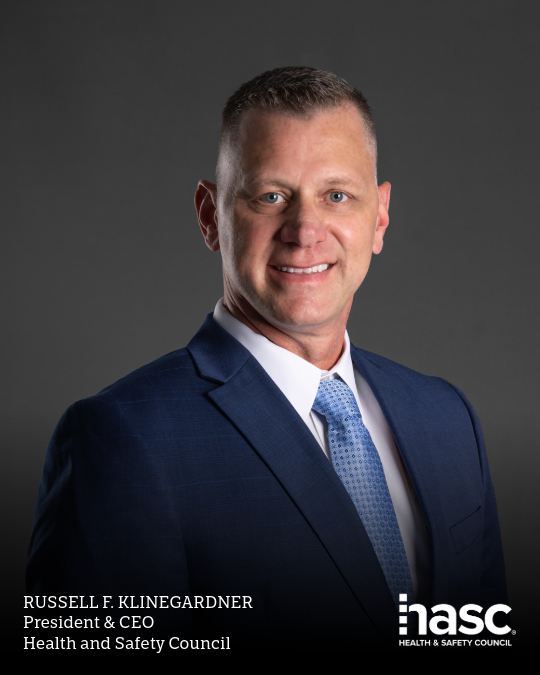
Russell F. Klinegardner
President & CEO
Health and Safety Council